
Air Q MCP
- Updated August 7, 2026
- CorantGmbH/mcp-airq
air-Q MCP is a MCP server that exposes direct HTTP access to local air-Q air quality sensors for coding agents.
About
air-Q MCP (mcp-airq) is a Model Context Protocol server that lets Claude Code, Cursor, Codex, and similar agents talk to air-Q air quality hardware over HTTP on your LAN. developers use it when a product or internal tool needs real PM2.5, CO₂, humidity, or related telemetry without building a custom HTTP client in every session. You install the PyPI package, point stdio transport at your MCP config, and supply either a JSON config file (AIRQ_CONFIG_FILE) or an inline device list (AIRQ_DEVICES). It fits IoT prototypes, wellness apps, and office monitoring where the sensor stays on the local network. Complexity is intermediate because you must understand device endpoints and secure configuration, but you avoid cloud API keys for pure local setups. After registration, your agent can query sensors as tools during build and operate workflows.
- Stdio MCP transport via PyPI package mcp-airq (v1.6.3)
- Direct HTTP to on-prem air-Q devices without cloud dependency
- Configure devices via AIRQ_CONFIG_FILE path or inline AIRQ_DEVICES JSON
- Suited for local labs, smart-home, and facility monitoring side projects
- Model Context Protocol server—not a standalone agent skill
Air Q MCP by the numbers
- Data as of Aug 10, 2026 (Skillselion catalog sync)
claude mcp add --env AIRQ_CONFIG_FILE=YOUR_AIRQ_CONFIG_FILE --env AIRQ_DEVICES=YOUR_AIRQ_DEVICES mcp-airq -- uvx mcp-airqAdd your badge
Show developers this MCP server is listed on Skillselion. Paste this into your README.

| Package | mcp-airq |
|---|---|
| Transport | STDIO |
| Auth | Required |
| Last updated | August 7, 2026 |
| Repository | CorantGmbH/mcp-airq ↗ |
What it does
Wire your coding agent to read live air-Q sensor readings over HTTP for dashboards, alerts, or automation scripts.
Who is it for?
Best when you have physical air-Q units and want agent-driven monitoring, scripting, or MVP dashboards on local HTTP.
Skip if: Skip if you only have cloud-linked devices and no local HTTP access—use air-Q Cloud MCP instead.
What you get
Your agent gains MCP tools to pull air quality metrics from configured devices using one stdio server registration.
- Registered stdio MCP server the agent can invoke for air-Q HTTP reads
- Repeatable device configuration via env vars without per-chat HTTP boilerplate
By the numbers
- Server version 1.6.3 on PyPI identifier mcp-airq
- Stdio transport only in published server schema
- 2 configuration env vars: AIRQ_CONFIG_FILE and AIRQ_DEVICES
README.md
mcp-airq







MCP server for air-Q air quality sensor devices. Enables Claude Desktop, Claude Code, and other MCP clients to directly query and configure air-Q devices on your local network.
Built on aioairq, the official async Python library for air-Q.
The same mcp-airq executable also works as a direct CLI when you pass a tool
name as a subcommand.
Installation
pip install mcp-airq
Or run directly with uvx:
uvx mcp-airq
CLI Usage
Use the same command directly from the shell:
mcp-airq list-devices
mcp-airq get-air-quality --device "Living Room"
mcp-airq get-air-quality-history --device "Living Room" --last-hours 12 --sensors co2
mcp-airq plot-air-quality-history --sensor co2 --output-format png
mcp-airq export-air-quality-history --sensor co2 --output-format xlsx
mcp-airq set-night-mode --activated --device "Bedroom"
For historical plots and exports:
- omit
device,location, andgroupto combine all configured devices into one artifact - use
locationorgroupto combine only the matching devices plot_air_quality_historyreturns one file per requested sensor, with one series per matching deviceexport_air_quality_historyreturns one CSV/XLSX file per request, with rows for all matching devices
The CLI subcommands mirror the MCP tool names. Both styles work:
mcp-airq list-devices
mcp-airq list_devices
To force MCP server mode from an interactive terminal, run:
mcp-airq serve
The CLI is pipe-friendly: successful command output goes to stdout, while
tool errors go to stderr with exit code 1.
mcp-airq get-air-quality --device "Living Room" | jq '.co2'
mcp-airq get-air-quality --device "Living Room" --compact-json | jq '.co2'
mcp-airq get-air-quality --device "Living Room" --yaml | yq '.co2'
Device Configuration
Create a JSON file with your device(s), e.g. ~/.config/airq-devices.json:
[
  {"address": "192.168.4.1", "password": "your_password", "name": "air-Q Pro", "location": "Living Room", "group": "Home"},
  {"address": "192.168.4.2", "password": "your_password", "name": "air-Q Radon", "location": "Living Room", "group": "Home"},
  {"address": "office_air-q.local", "password": "other_pass", "name": "Office", "group": "Work"}
]
Each entry requires:
address— IP address or mDNS hostname (e.g.abcde_air-q.local)password— Device password (default:airqsetup)name(optional) — Human-readable name; defaults to addresslocation(optional) — Physical room/area for grouping (e.g."Living Room")group(optional) — Second grouping dimension, orthogonal to location (e.g."Home","Work")
Then restrict access to the file (it contains passwords):
chmod 600 ~/.config/airq-devices.json
Alternatively, pass the device list inline via the AIRQ_DEVICES environment variable as a JSON string.
Claude Desktop
Add to your claude_desktop_config.json:
{
  "mcpServers": {
    "airq": {
      "command": "uvx",
      "args": ["mcp-airq"],
      "env": {
        "AIRQ_CONFIG_FILE": "/home/you/.config/airq-devices.json"
      }
    }
  }
}
Claude Code
Register the server once via the CLI:
claude mcp add airq -e AIRQ_CONFIG_FILE=~/.config/airq-devices.json -- uvx mcp-airq
This writes to ~/.claude/settings.json and is automatically picked up by the Claude Code VSCode extension as well — no separate configuration needed.
If the server fails to connect: MCP servers run in a subprocess that may not inherit your shell's PATH. Replace
uvxwith its full path (which uvx→ e.g./home/you/.local/bin/uvx):claude mcp add airq -e AIRQ_CONFIG_FILE=~/.config/airq-devices.json -- /home/you/.local/bin/uvx mcp-airq
OpenAI Codex
Register the server once via the CLI:
codex mcp add airq --env AIRQ_CONFIG_FILE=~/.config/airq-devices.json -- uvx mcp-airq
This writes to ~/.codex/config.toml and is automatically picked up by the Codex VSCode extension as well.
If the server fails to connect: Use the full path to
uvx(see note above).
Available Tools
Read-Only
| Tool | Description |
|---|---|
list_devices |
List all configured air-Q devices (with location/group if set) |
get_air_quality |
Get sensor readings — by device, location, or group |
get_air_quality_history |
Get historical sensor data as column-oriented JSON |
plot_air_quality_history |
Render one historical chart per sensor across all matching devices |
export_air_quality_history |
Export one historical sensor as one csv/xlsx across matching devices |
get_device_info |
Get device metadata (name, model, firmware version) |
get_config |
Get full device configuration |
get_logs |
Get device log entries |
identify_device |
Make device blink its LEDs for visual identification |
get_led_theme |
Get current LED visualization theme |
get_possible_led_themes |
List all available LED visualization themes |
get_night_mode |
Get current night mode configuration |
get_brightness_config |
Get current LED brightness configuration |
Configuration
| Tool | Description |
|---|---|
set_device_name |
Rename a device |
set_led_theme |
Change LED visualization (CO₂, VOC, Humidity, PM2.5, …) |
set_night_mode |
Configure night mode schedule and settings |
set_brightness |
Adjust LED brightness (day/night) |
configure_network |
Set static IP or switch to DHCP |
Device Control
| Tool | Description |
|---|---|
restart_device |
Restart the device (~30s downtime) |
shutdown_device |
Shut down the device (manual restart required) |
Multi-Device Support
When multiple devices are configured, specify which device to query:
- By exact name:
"air-Q Pro" - By partial match (case-insensitive):
"pro","radon"
If only one device is configured, it is selected automatically.
Location and Group Queries
get_air_quality accepts two optional grouping parameters:
location— query all devices in the same room (e.g."Living Room")group— query all devices sharing a group tag (e.g."Home")
Both are independent: a device can have a location, a group, both, or neither. Matching is case-insensitive and substring-based.
get_air_quality(location="Living Room")  → air-Q Pro + air-Q Radon
get_air_quality(group="Home")            → air-Q Pro + air-Q Radon + …
get_air_quality(device="air-Q Radon")   → just that one device
Exactly one of device, location, or group may be specified per call.
Historical Data
Three tools provide access to data stored on the device's SD card:
Plotting charts
plot_air_quality_history renders a chart for one sensor. When multiple devices
match, each device becomes a separate series in the same chart.
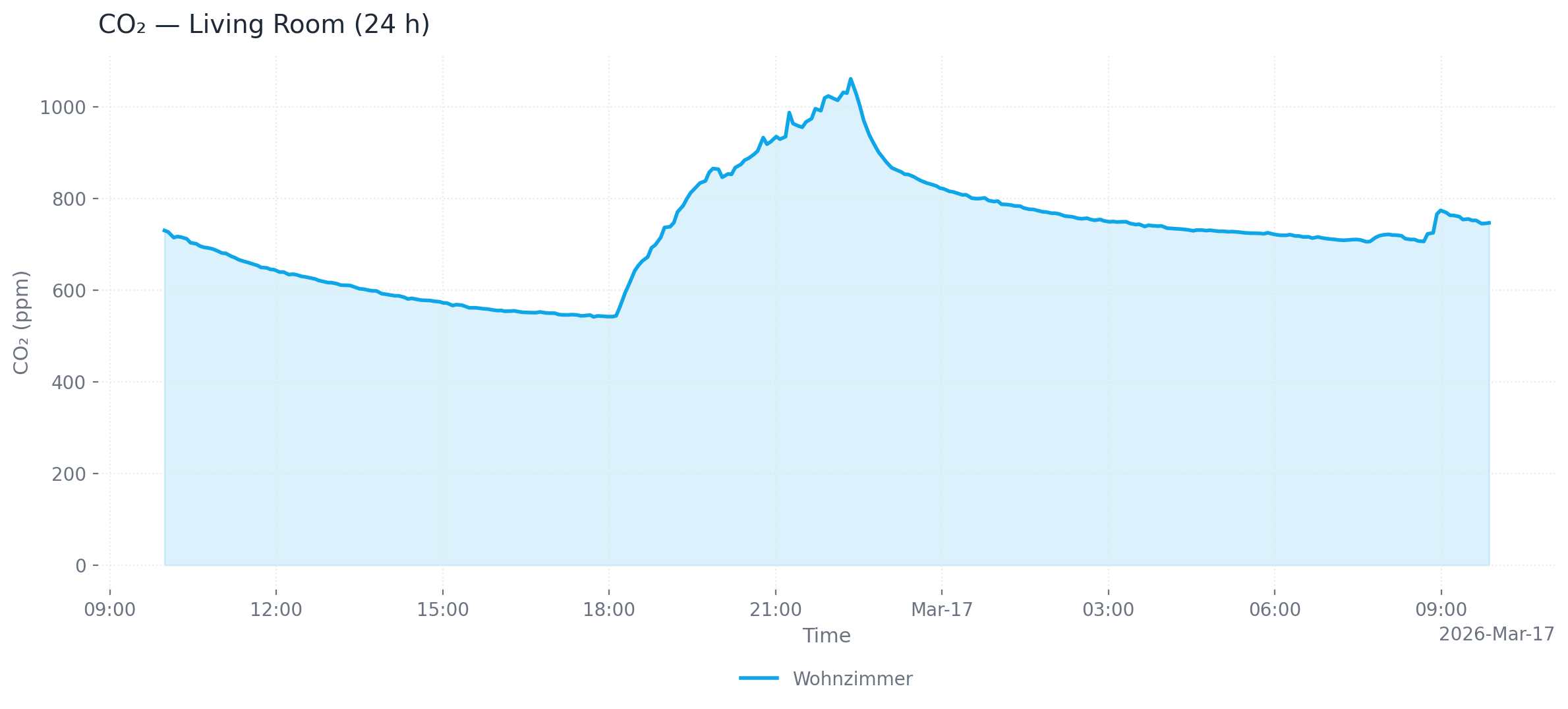
Single device (24 h, area chart, PNG)
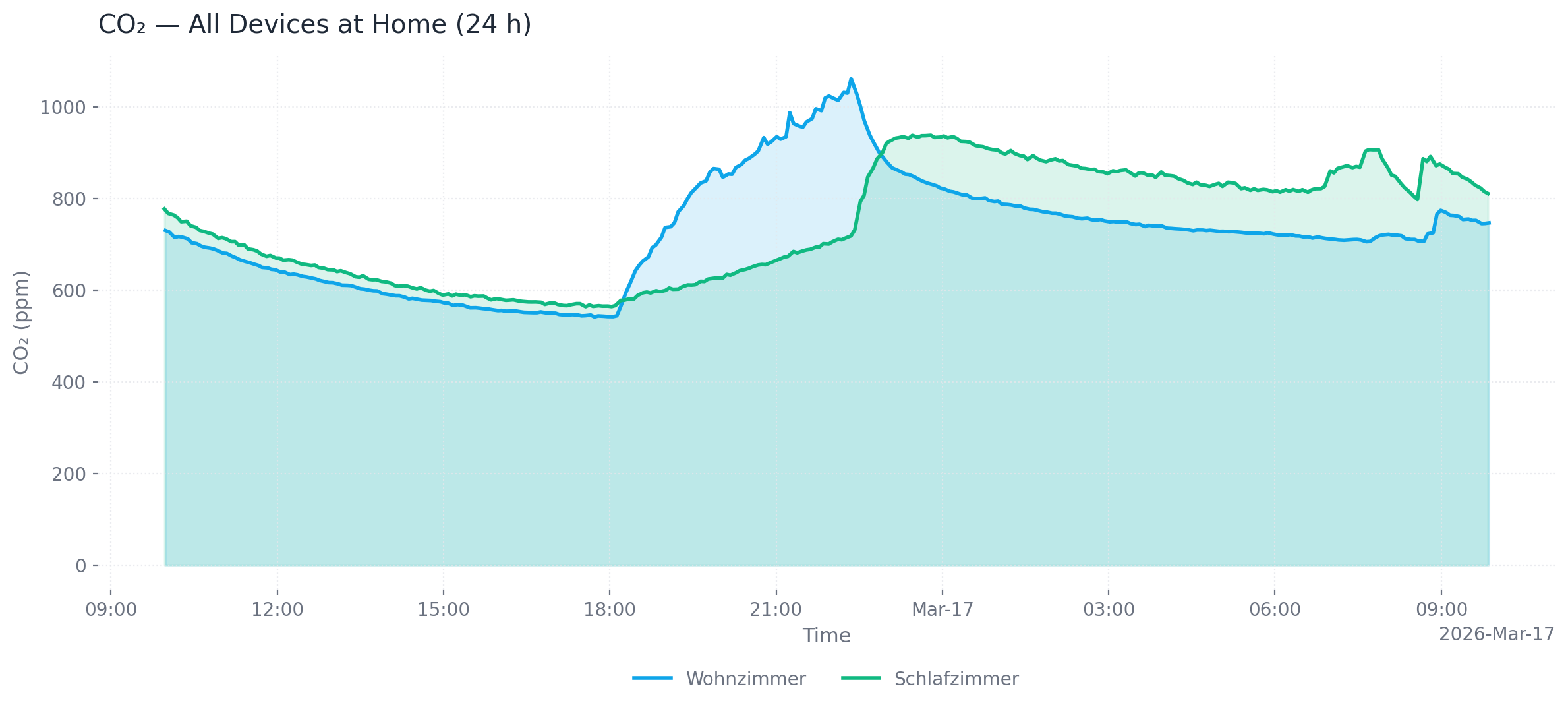
Multiple devices at one location (24 h, area chart, PNG)
# Single device, last 24 hours (default), PNG output (default)
mcp-airq plot-air-quality-history --sensor co2 --device "Living Room"

# All devices at a location, custom time range, SVG output
mcp-airq plot-air-quality-history --sensor co2 --location "Living Room" \
  --from-datetime "2026-03-16T00:00:00" --to-datetime "2026-03-17T00:00:00" \
  --output-format svg --output co2.svg

# All configured devices, dark mode, line chart
mcp-airq plot-air-quality-history --sensor co2 --dark --chart-type line

# Save to file
mcp-airq plot-air-quality-history --sensor co2 --output co2_chart.png
Output formats: png (default), webp, svg, html (interactive Plotly chart with hover tooltips and zoom)
Customization: --title, --x-axis-title, --y-axis-title, --chart-type (line/area), --dark, --timezone-name
Exporting data
export_air_quality_history produces one CSV or Excel file containing all matching devices.
# CSV export (default)
mcp-airq export-air-quality-history --sensor co2 --device "Living Room" --last-hours 48

# Excel export for all devices at a location
mcp-airq export-air-quality-history --sensor radon --location "Home" \
  --output-format xlsx --output radon.xlsx
Querying raw JSON
get_air_quality_history returns column-oriented JSON, useful for programmatic analysis.
mcp-airq get-air-quality-history --device "Living Room" --last-hours 12 \
  --sensors co2 pm2_5 --max-points 150
Common parameters
| Parameter | Default | Description |
|---|---|---|
--last-hours |
1 (history) / 24 (plot) | Hours of data to retrieve |
--from-datetime / --to-datetime |
— | ISO 8601 time range (overrides --last-hours) |
--max-points |
300 | Downsample to at most N evenly spaced points |
--timezone-name |
UTC | IANA timezone for timestamps (e.g. Europe/Berlin) |
Example Prompts
- "How is the air quality in the living room?" — queries all devices at that location
- "What's the air quality at home?" — queries all devices in the "Home" group
- "Show the CO₂ trend over the last 12 hours as SVG"
- "Export the radon history from yesterday as Excel"
- "Show me the radon level" — targets the air-Q Radon device by name
- "Show CO₂ on the LEDs"
- "Enable night mode from 10 PM to 7 AM"
- "Set brightness to 50%"
- "What's in the device log?"
- "Make the air-Q blink"
Development
git clone https://github.com/CorantGmbH/mcp-airq.git
cd mcp-airq
uv sync --frozen --extra dev
uv run pre-commit install
uv run pytest
The repository uses a project-local .venv plus uv.lock for reproducible tooling.
Run all developer commands through uv run, for example:
uv run ruff check .
uv run ruff format --check .
uv run pyright
uv run pre-commit run --all-files
Release Process
- Update
versioninpyproject.toml. - Commit and create a matching Git tag like
v0.1.1. - Publish a GitHub Release from that tag.
The publish workflow validates that the release tag matches pyproject.toml, uploads the package to PyPI, and then publishes the same version to the MCP Registry.
License
Apache License 2.0 — see LICENSE.
Recommended MCP Servers
 Agent Audit MCPImmutable audit trail for agent-to-agent interactions2
 Agentguard47 MCPRead-only MCP server for coding-agent traces, alerts, costs, usage, and budget health.4
 Agentic Observability MCPAgent tracing, cost tracking, anomaly detection for LLM agents
 Agent Incident Relay MCPAgent Incident Relay MCP — Article 73 5-clock broadcaster.
 Agent Infra MCP18 tools: agent memory, API drift detection, and HMAC-signed trust receipts
 Agentmonitorrelay MCPAI agent run monitoring with incident replay and SLA receipts.
How it compares
MCP device integration over stdio, not a curated skills marketplace listing or generic web-scraping skill.
FAQ
Who is Air Q MCP MCP for?
Developers running Air Q MCP hardware on a local network who want Claude Code, Cursor, or Codex to query live air quality data through MCP tools.
When should I use Air Q MCP MCP?
Use it during build or operate when your agent must read on-prem Air Q MCP sensors via HTTP and you prefer file- or env-based device configuration without the Cloud API.
How do I add Air Q MCP MCP to my agent?
Install the mcp-airq PyPI package, add a stdio MCP server entry in your agent config, and set AIRQ_CONFIG_FILE or AIRQ_DEVICES with your device definitions.